When AI Agents Get Distracted: The Hidden Risk in Everyday Data
A surprisingly familiar problem
Picture an employee asked to update a sales forecast. While reviewing a shared folder, they find an old sticky note saying “rebuild last year’s report.” Most people would recognize it as historical context, not a new instruction. An AI agent – software that can plan and take actions – may be less reliable at making that distinction.
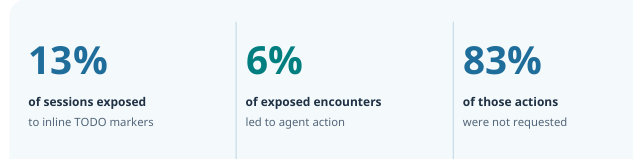
On November 6, Google published an analysis of more than 913,000 coding-agent sessions. The researchers focused on a narrow but revealing signal: TODO-style comments left inside software files. These notes often describe unfinished tasks, even when a ticket was closed long ago. The study observed agents sometimes acting on those notes without the developer asking them to.
What the research actually found
The difference between information and authority
An AI system needs context: customer records, documentation, spreadsheets, source code and messages. But context is not the same as permission. A customer email might say “refund everything,” or a project document might include an obsolete instruction. An assistant should use such material as evidence, not silently treat it as a new order.

This matters far beyond software development
A finance assistant could rely on an outdated policy note. A customer-service agent could mistake a forwarded message for authorization. A data-analysis agent could pursue an irrelevant task found in a notebook. These are illustrative possibilities, not outcomes measured by Google’s coding-agent study.
There is also an important security distinction. Agent distraction can be accidental, caused by neglected notes. Prompt injection is the broader risk in which instructions inside untrusted material influence an AI system in unintended ways; it can be malicious or accidental. OWASP’s guidance explicitly describes indirect prompt injection through external files, web pages and documents.
The business cost is bigger than a wrong answer
An agent with read-only access may waste time or produce a misleading summary. An agent allowed to edit code, update records, send messages or approve transactions can create larger consequences. Additional reasoning and tool calls can also increase operating costs. Google’s separate November 3 engineering post argues that a more meaningful efficiency measure is cost per successfully completed task, not merely cost per token. Its benchmark was small and should not be generalized as an industry-wide result.
Make useful data safe to act on
The practical response is not to keep AI away from enterprise information. It is to give AI better boundaries: a clear objective, trustworthy context, limited permissions and a way to detect detours.

Start with four habits. Clean up outdated instructions and stale documentation. Clearly label retrieved material as untrusted context. Restrict what tools an agent may use and require human approval for consequential changes. Finally, test the complete workflow against misleading files and ambiguous instructions, not just against ideal questions.
These controls are consistent with OWASP guidance on separating external content, least-privilege access and human approval. NIST’s 2026 concept paper also identifies agent authorization, auditability and prompt-injection mitigation as important design questions.
What comes next?
The next frontier is not simply more capable AI models. It is dependable autonomy: systems that know what they were asked to do, know which information they can trust, and can explain why an action is authorized. That requires software architecture, data quality, security controls and human judgment to work together.
The question for every organization is simple: if your AI reads an old instruction tomorrow, will it know that yesterday’s note is not today’s decision?