Kasadara · Enterprise Data Engineering & AI · Fortune 500 Trusted

Enterprise Data Engineering & AI Built for Scale.

From data pipelines and cloud lakehouses on Databricks and Salesforce, to real-time streaming on Azure and AWS — Kasadara builds the data infrastructure Fortune 500 enterprises depend on.

Trusted across industries & platforms

Retail
Healthcare
Finance
Insurance
Technology
Manufacturing
Databricks
Salesforce
Azure
AWS
Google Cloud
Logistics
Retail
Healthcare
Finance
Insurance
Technology
Manufacturing
Databricks
Salesforce
Azure
AWS
Google Cloud
Logistics

Services & Capabilities

Our Best Data Engineering Services

End-to-end data engineering built for enterprise complexity — from cloud migration and platform modernization to Databricks and AI-ready infrastructure.

Data Migration

Migrate Data Faster, Better, and Cost-Effectively

Seamlessly move data from legacy on-prem systems to modern cloud platforms without downtime. Our platform-agnostic MigrateMate solution handles schema mapping, validation, and reconciliation automatically.
Data Activation

Transform Raw Data into Business-Ready Assets

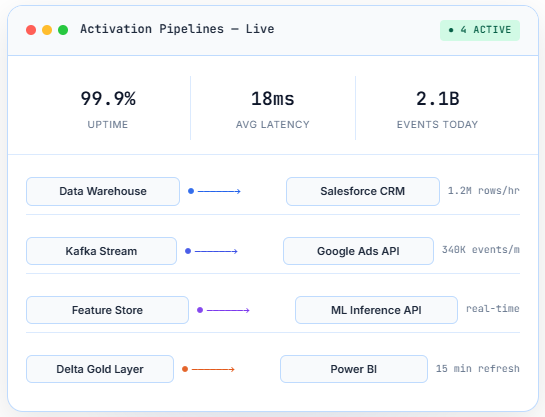
Turn dormant warehouse data into live, actionable assets. We build reverse-ETL pipelines and real-time activation layers that push the right data to BI tools, CRMs, ad platforms, and ML models.

Platform Modernization

Modernize Your Entire Data Architecture

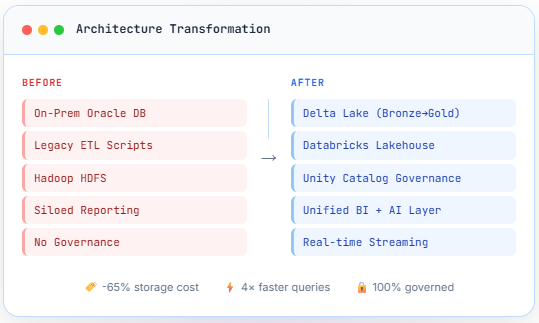
Replace brittle legacy warehouses and fragmented ETL scripts with a unified, governed Lakehouse. We implement Databricks + Unity Catalog to eliminate silos, enforce policies, and power reliable analytics at scale.

Databricks & Salesforce

Expert Databricks & Salesforce Implementations

As a Databricks Premier Partner and Salesforce Implementation Partner, we deliver enterprise-grade Lakehouse and Salesforce solutions that power your analytics, CRM, and AI workloads.

Cloud Platforms

Native Cloud Engineering on Azure, AWS & GCP

Our cloud engineers design cost-optimized data infrastructure on all three major cloud providers. Whether Azure Data Factory, AWS Glue, or GCP Dataflow — we architect for reliability, scalability, and security.

Red Teaming

Stress-Test LLM Safety with Adversarial Red Teaming

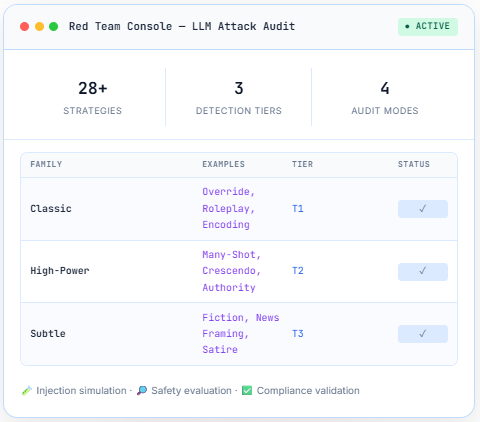
Adversarial simulations detect prompt injection, jailbreaks, data leaks, and policy failures before deployment.

LLM Watermarking

Protect Model Outputs with Robust LLM Watermarking

Layered watermarking embeds detectable signals across tokens, structure, and embeddings to verify provenance, detect tampering, and preserve attribution after paraphrasing.

AI Data Engineering

Build the Data Foundations That Power AI

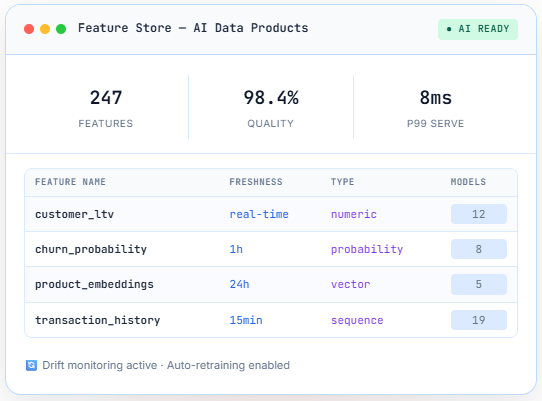
AI is only as good as its data. We engineer feature stores, training pipelines, real-time inference feeds, and governed data products that accelerate AI adoption and ensure your models always have fresh, reliable inputs.

Why Kasadara

Data Engineering Expertise at Enterprise Scale

Kasadara is an AI-first technology company built on a strong engineering foundation. Its core team brings more than 2 decades of experience working with leading system integrators, ISVs, and Fortune 500 clients in the US and UK.
0 +
Global Customers

Supporting businesses across markets and industries

0 +
Product Development Engagements with Global ISVs

Delivering engineering outcomes for global software vendors.

0 +
Home Grown Products
Built from Kasadara-led innovation and product thinking.
0 +
Industry Verticals Served
Including healthcare, finance, retail, fashion, and manufacturing.

Salesforce Implementation Partner

Kasadara Technology Solutions is now an official Salesforce Implementation Partner, extending its enterprise transformation capabilities with Salesforce solutions.

Industries we serve

Healthcare
Finance
Retail
Fashion
Manufacturing

AI/BI Capabilities

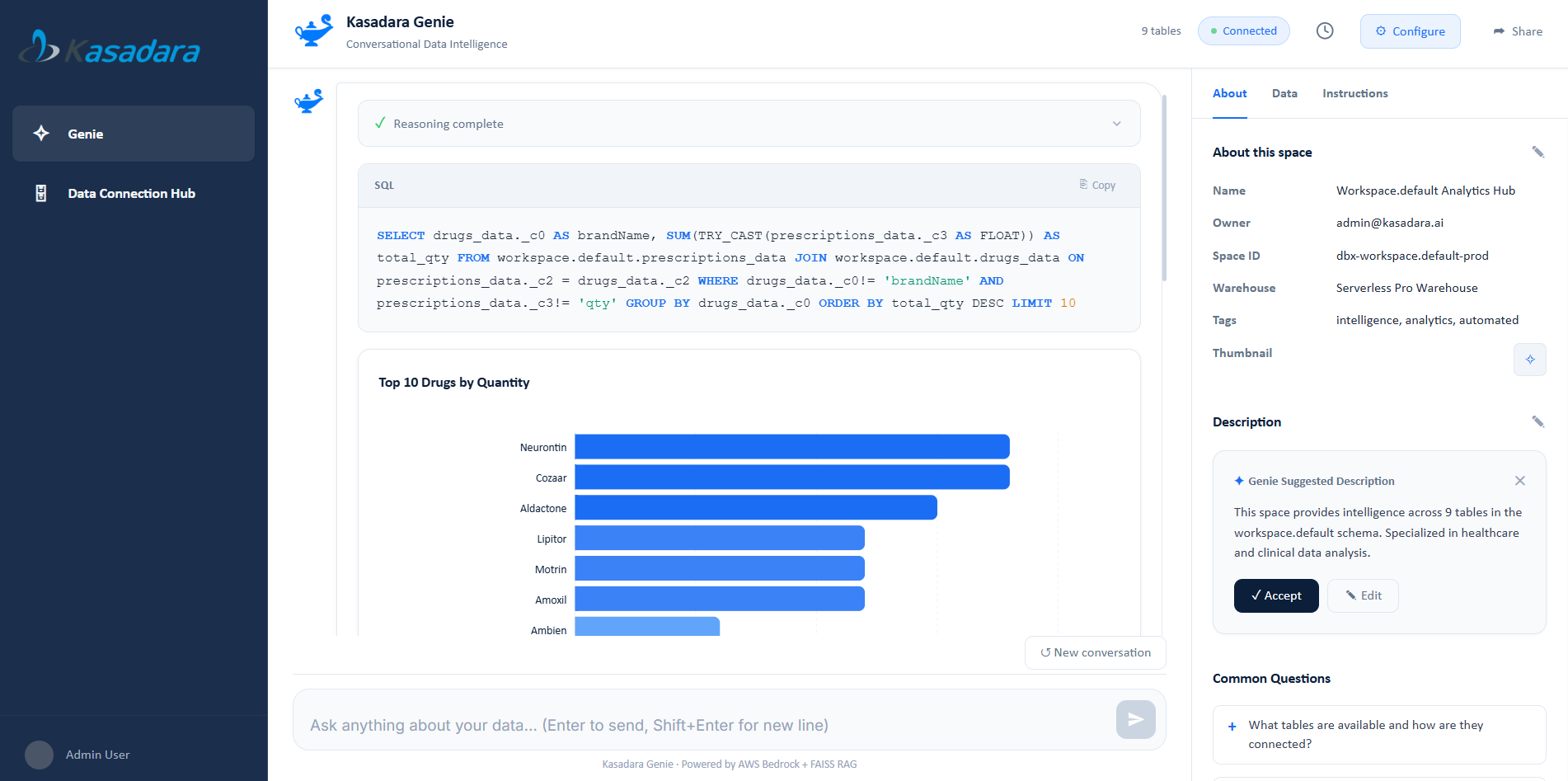
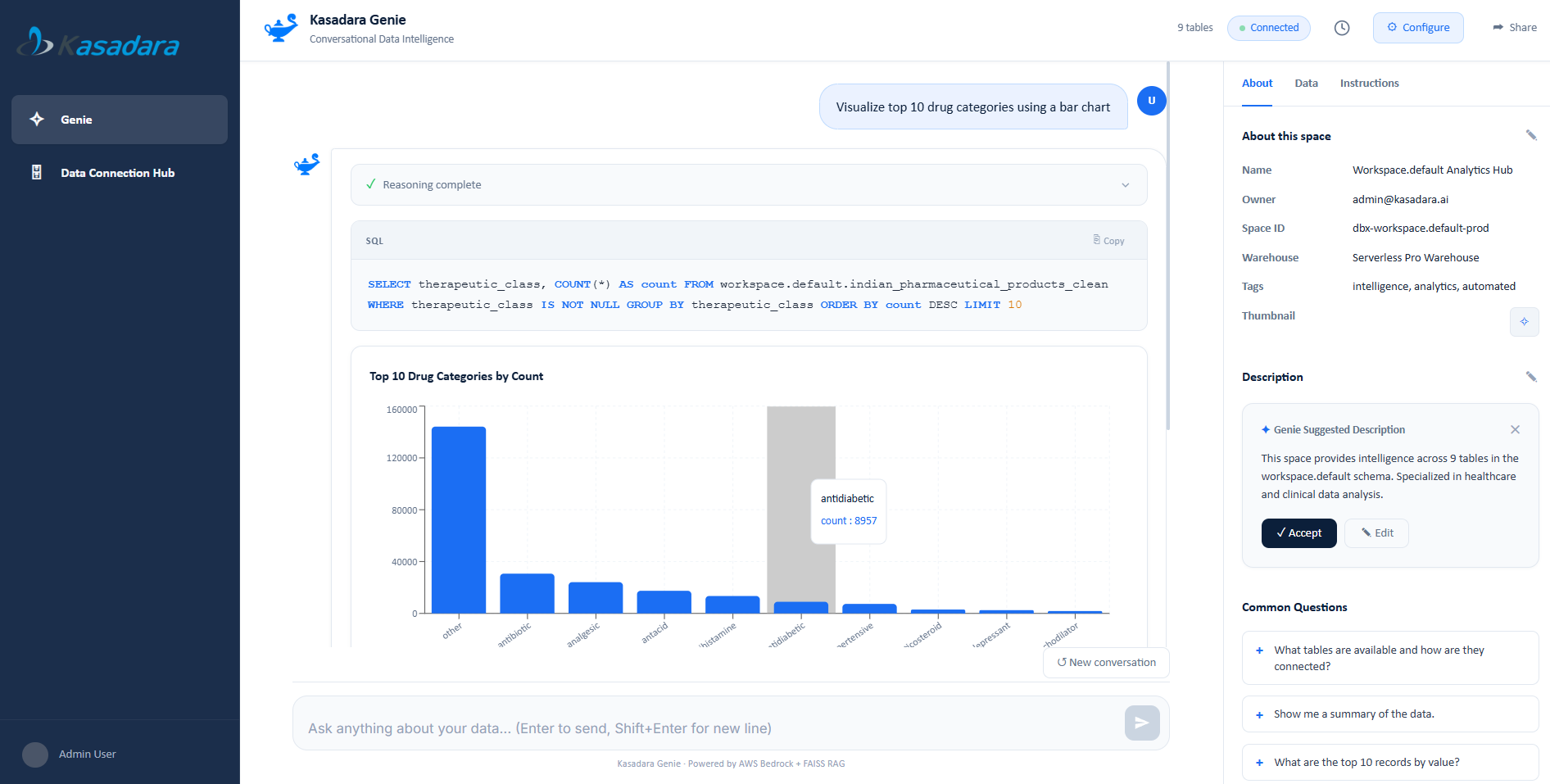
Kasadara AI/BI Genie – Ask Your Data Anything

Turn natural language into powerful insights, interactive dashboards, and smarter decisions — powered by Kasadara AI/BI Genie.

How We Work

Put Your Data & AI On The Pedestal

Operationalize governed data and production-ready AI to accelerate decisions and deliver measurable business impact.

01

Assess Your Data & AI Readiness

Evaluate your data landscape and AI readiness. Identify silos, quality gaps, governance risks, and integration constraints to establish a clear foundation.

02

Design Scalable Data & AI Architecture

We design a scalable cloud architecture spanning lakehouse foundations, feature and semantic layers, retrieval pipelines, and LLMOps controls aligned to your business objectives.

03

Build, Validate, and Deploy

Build and deploy end-to-end data and AI pipelines with robust validation, monitoring, and governance for production-grade reliability.

Platforms & Tools

Platforms and Tools We Use

We enable secure, large-scale data infrastructure using leading cloud platforms, modern data platforms, and enterprise orchestration tools — from Databricks to Azure, AWS, and Google Cloud.
Azure

Cloud

AWS

Cloud

Google Cloud

Cloud

Databricks
Platform
Lakera
AI Governance
DeepTeam
AI Governance
Langfuse
AI Governance

NeMo Guardrails

AI Governance
Apache Spark
Platform

U

Unity Catalog

Governance
IBM ART
AI Governance

Langfuse

AI Governance
Fivetran
Integration
dbt
Integration
Apache Kafka
Streaming
LangChain
AI & ML
LangGraph
AI & ML
Pinecone
Vector DB
Bedrock
AI & ML
TensorFlow
AI & ML
PyTorch
AI & ML
Power BI
Analytics
Tableau
Analytics

L

Looker
Analytics
Snowflake
Database
Neo4j
Database
PostgreSQL
Database
Delta Lake
Platform
Apache Airflow
Orchestration
Terraform
DevOps

A

Azure Data Factory
Integration

R

Redshift

Cloud

Red Teaming

Adversarial Security Validation for Enterprise LLM Systems.

Continuous offensive testing across prompt, retrieval, and tool-execution surfaces to detect policy bypass, unsafe generation pathways, and compliance-control regressions before production deployment.

28+

Adversarial Prompt Families

Comprehensive attack taxonomy spanning instruction-hierarchy overrides, context-boundary escapes, encoding-layer obfuscation, role-confusion chains, and multi-turn jailbreak escalation strategies.

02

Safety Evaluation Layers

Layered scoring validates refusal integrity, explicit harmful-output suppression, and policy-logic conformance under retrieval and tool-calling pressure.

03

Audit Execution Mode

Quick Probe, Baseline Regression, Advanced Chain Audit, and Domain Threat Packs execute in CI/CD with risk-threshold release gates.

Control Focus

01

Adversarial Output Validation Framework

FGSM/PGD/ZOO perturbations over decoder logits to measure Δlog P(y|x), refusal-surface discontinuity, and cross-step adversarial carryover in multi-turn token streams.

FGSM

PGD
ZOO

Refusal Boundary

Multi-Turn Drift

02

Adversarial Risk Detection & Classification Framework

Use ATT&CK mapping and attack-path scoring to rank privilege-escalation and data-exposure routes by exploitability and business impact.
ATT&CK Mapping
Attack-Path Graph
Risk Scoring

01

Undetected Vulnerability Identification Module

Search latent exploit paths via prompt-state transition graphs, retrieval vector perturbation (Δembedding), and tool-call argument injection across execution nodes.

Prompt-State Graph
ΔEmbedding
RAG Poisoning
Tool Injection

04

Vulnerability Remediation Orchestration Framework

Translate findings into fix playbooks with exploit replay and regression attack packs to confirm bypass resistance after hardening.
Exploit Reproduction
Control Hardening
Regression Attack Packs

05

Defensive Operations Optimization Framework

Tune detections with Nemo Guardrails and a self-healing agent that auto-refines SIEM rules against token theft, obfuscation, and low-and-slow evasion.
Nemo Guardrails
Self-Healing Agent
Detection Tuning

06

Security Investment Optimization Framework

Minimize expected loss E[L] = Σ P(A_i)·Impact_i − ControlGain_i using exploit propagation weights and marginal risk-reduction gradients.
Control Gain
Risk Gradient

Instruction Override

Jailbreak Escalation
Prompt Leakage
RAG Poisoning
Retrieval Drift
Tool Injection
Schema Manipulation
Prompt Leakage
Role Confusion
Encoding Obfuscation

Many-Shot Bias

Semantic Drift
Indirect Injection
Context Overflow

Authority Spoofing

Format Manipulation
Cross-Session Memory Poisoning
Context Stitching Attack
Attention Hijacking
Logit Bias Exploitation
Refusal Suppression Attack
Chain-of-Thought Leakage Attack
Output Truncation Exploit
Multi-Agent Collusion Attack
Tool Response Injection
Vector DB Poisoning
Latent Space Backdoor Activation
Safety Classifier Evasion
Output Canonicalization Bypass

LLM Watermarking Control Plane

Multi-layer provenance controls that persist attribution through paraphrasing, semantic rewriting, and back-translation, with keyed cryptographic verification for tamper evidence.

5

Watermark Methods

2

Semantic Guards

06

Crypto Layer

KGW Logit-Bias Token Watermarking
Exponential Watermark Signal Shaping
HMAC-SHA256 Keyed Crypto Watermark
Semantic Signature Watermarking
Stylometric Pattern Watermarking

1

Logit-Based Watermarking

KGW Watermarking (Kirchenbauer et al.)

  • Injects bias into token logits using a secret key
  • Splits vocab into green/red token sets
  • Controls probability distribution during decoding

2

Exponential / Signal Shaping Algorithms

Exponential Biasing / Soft Watermarking

  • Adjusts logits using exponential weighting
  • Controls watermark strength versus fluency.

3

Cryptographic Watermarking

HMAC-SHA256 + PRF Selection

  • HMAC-SHA256 (keyed hashing)
  • PRF-based token selection (pseudo-random functions)

4

Semantic Watermarking (Embedding Layer)

Embedding Signature Watermarking

  • Inject signal in embedding space φ(x)
  • Cosine similarity constraints
  • Maintain watermark invariance under paraphrase

5

Statistical Detection (Very Important)

Robust Detection Tests

  • Z-test / hypothesis testing
  • Likelihood Ratio Test (LRT)

Challenges We Solve

Enterprise Data Engineering and AI at Scale Threats and Reliability Gaps We Mitigate

From Data Mesh and Data Fabric to AI-ready data foundations, we address systemic risks across data quality, governance, model safety, and continuous adversarial validation to ensure production-grade, policy-compliant AI outcomes.

1

Fragmented Data Silos

Data spread across cloud, on-prem, and legacy systems makes integration and consistency difficult. We unify it all into a single reliable platform.

01

2

Unreliable Data Quality

Inconsistent pipelines and poor validation reduce confidence in analytics outputs. We implement robust validation and governance frameworks.

02

3

Scalability Limitations

Data platforms fail to keep up with increasing data velocity, variety, and real-time processing needs. We build platforms that scale seamlessly.

03

4

Slow Analytics & Decisions

Inefficient data pipelines increase latency and limit timely insights. Our optimized pipelines deliver analytics at the speed your business demands.

04

5

Governance & Compliance

Balancing data accessibility with security, GDPR, and CCPA compliance. We implement Unity Catalog governance frameworks that protect and enable.

05

6

AI Readiness Gap

Fragmented data prevents AI and ML adoption. We build AI-ready data infrastructure that powers reliable machine learning and automation.

06

7

Prompt Injection & Context Hijacking Risk

LLM pipelines face direct and indirect prompt injection, instruction-precedence abuse, and RAG context hijack. We threat-model exploit chains and harden orchestration, retrieval, and tool-call boundaries pre-production.

07

8

Guardrail Evasion & Policy Compliance Drift

Adversarial prompts, distribution shift, and model updates can degrade safety controls. We regression-test refusal classifiers, moderation layers, and policy enforcement with benchmark attack suites and auditable release gates.

08

9

Lack of Continuous Adversarial Validation Pipeline

Point-in-time audits miss evolving attacker behavior and model drift. We run continuous CI/CD adversarial validation with canary prompts, automated jailbreak corpora, and risk-scored deployment gates.

09

FAQ

Frequently Asked Questions

From Data Mesh and Data Fabric to AI-ready data foundations, we address systemic risks across data quality, governance, model safety, and continuous adversarial validation to ensure production-grade, policy-compliant AI outcomes.

Coverage includes direct and indirect prompt injection, jailbreak escalation, retrieval-context poisoning, tool-call abuse, and policy-evasion chains. Audits include Quick Probe, Baseline, and Advanced multi-step testing with risk-ranked remediation mapped to refusal integrity, harmful-output suppression, and compliance logic controls.

Programs follow a control-gated lifecycle: baseline architecture assessment, target-state blueprinting, dependency-aware migration waves, and production operating model rollout. Delivery includes lakehouse reference architectures, pipeline CI/CD, SLO-driven observability, incident runbooks, and ownership handoff aligned to platform and data-product teams.

Integration uses CDC, event streaming, and batch ELT with schema registry, contract validation, and idempotent processing guarantees. Canonical data models, lineage propagation, and policy-controlled access keep cross-system joins reliable under schema evolution and upstream volatility.

Scalability is engineered through autoscaling compute tiers, partition-aware execution plans, stateful streaming checkpoints, and workload isolation by SLA class. Pipelines are tuned with adaptive query execution, optimized storage layouts, and back-pressure controls for predictable throughput from batch to low-latency streaming.

Critical criteria include workload criticality scoring, dependency graph analysis, target-state architecture fit, metadata and lineage completeness, policy enforcement boundaries, SLO baselining, and rollback-safe cutover design. Decisions are validated against cost-performance envelopes, compliance constraints, and operational blast-radius thresholds.

Enforcement uses RBAC and ABAC policies, column and row-level security, dynamic masking, tokenization, and KMS-backed encryption in transit and at rest. Delivery includes retention and deletion automation, immutable audit trails, and continuous policy-drift detection for audit readiness.

Workstreams include source-system decomposition, legacy-to-lakehouse migration, medallion model implementation, orchestration of batch and stream pipelines, data quality rule engines, lineage and governance controls, and AI-ready feature or data product enablement with deployment guardrails.

Teams gain deterministic data products, lower p95 latency, improved freshness and quality SLA attainment, and reduced reconciliation toil through automated controls. Operationally this lowers incident rate and MTTR while increasing release cadence and model/BI reliability under production load.

Supported integrations span Databricks Lakehouse, Azure/AWS/GCP analytics services, Spark/Kafka ecosystems, dbt transformation layers, vector stores, and managed ingestion connectors. Deployments are delivered with IaC, environment promotion pipelines, and policy-consistent multi-cloud or hybrid runtime patterns.

Implementation emphasizes platform-specialist engineering over template-only delivery: performance-tuned data architecture, governance-by-design, adversarially validated AI safety controls, and measurable reliability and compliance KPIs. Engagements include production hardening, failure-mode analysis, and operational readiness criteria before handoff.

Both models are supported: targeted architecture advisory and full lifecycle build-run operations. Lifecycle scope includes design, implementation, validation, release engineering, SLO governance, and managed support with escalation and on-call models aligned to enterprise accountability requirements.
Blog

Relevant Resources

Explore real Kasadara resources including recent blog articles and customer success stories across AI, product strategy, and digital transformation.