Stop Asking Which AI Model to Use – Start Asking What Business Problem to Solve

A few years ago, if someone had told us that we could have conversations with a computer almost like talking to another person, we would have laughed.
Today, that’s exactly what tools like ChatGPT, Claude, Gemini, and others have made possible.
Naturally, every organization wants to use AI.
The first question most businesses ask is:
“Which AI model should we use?”
Should it be GPT? Claude? Gemini? Llama?
But after working on enterprise AI solutions, I’ve come to believe that this is the wrong question.
The better question is:
“How can multiple AI capabilities work together to solve a real business problem?”
That’s the idea behind Multimodal AI.
Let's start with something simple
Imagine you’re helping your friend buy a used car.
Your friend doesn’t just tell you, “The car looks good,” and you immediately say, “Buy it.”
Instead, you would probably:
- Look at photos of the car.
- Listen to the sound of the engine.
- Read the service history.
- Check the registration documents.
- Ask questions about previous accidents.
- Compare the price with similar cars.
Only after gathering all this information would you make a recommendation.
Why?
Because every piece of information tells part of the story.
Humans naturally combine information from different sources before making decisions.
For a long time, AI couldn’t do that very well.
Most AI systems only understood text.
If you showed them a photograph, a scanned invoice, a handwritten note, or a short video, they either ignored it or required another tool to process it first.
That limitation is disappearing.
What is Multimodal AI?
The word sounds complicated, but the concept isn’t.
Think of the word in two parts:
- Multi = many
- Modal = different ways information is presented
So Multimodal AI simply means:
AI that can understand and combine different types of information instead of just reading text.
Those different types of information could include:
- Documents
- Images
- Audio recordings
- Videos
- Emails
- Tables
- Charts
- Handwritten notes
- Structured business data
- Sensor readings
Just like people, the AI looks at everything together before responding.
Why is this such a big deal?
Because businesses don’t run on text alone.
Think about your own workplace.
Every day you probably work with:
- Excel spreadsheets
- PDF reports
- PowerPoint presentations
- Emails
- Teams or Slack messages
- Images
- Signed contracts
- Scanned invoices
- Dashboards
- Voice recordings
- Videos
Now imagine asking AI to help you make a decision.
If the AI only understands text, someone has to manually describe everything.
Imagine explaining a complex graph in words.
Or describing a damaged machine without sharing a photograph.
Or typing out every detail from a twenty-page contract.
That takes time.
More importantly, valuable information gets lost.
Multimodal AI removes much of that effort.
Multimodal AI
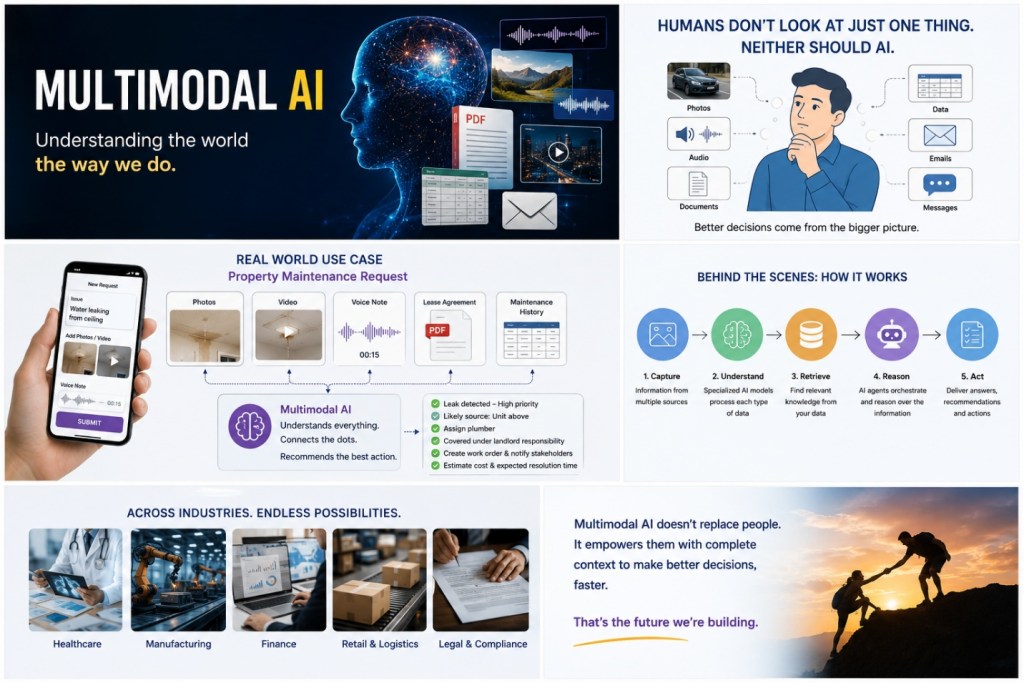
Let’s imagine a property management company.
A tenant wakes up one morning and discovers water dripping from the ceiling.
Using a mobile app, they submit a maintenance request.
Along with the request, they upload:
- Four photographs of the damaged ceiling.
- A short video showing water actively leaking.
- A voice recording explaining when the leak started.
- A copy of their lease agreement.
- Previous maintenance reports.
Now imagine two different systems.
Traditional AI
It reads:
“Water leaking from ceiling.”
It replies:
“Thank you. Your complaint has been registered.”
That’s about it.
Multimodal AI
Now the AI looks at everything together.
It notices from the images that the ceiling already shows signs of mold.
It observes from the video that the leak is still active.
It listens to the tenant’s voice recording and understands that the water started only a few hours ago.
It reads the lease agreement and identifies that structural repairs are covered by the property owner.
It checks maintenance records and discovers that the apartment above had plumbing repairs just three months ago.
It even compares the damage with thousands of previous maintenance cases.
Instead of simply logging the complaint, the AI concludes:
- This is an urgent repair.
- The likely source is plumbing from the apartment above.
- A plumbing technician should be assigned immediately.
- The repair falls under landlord responsibility.
- Notify both tenants.
- Inform the maintenance supervisor.
- Generate the work order automatically.
- Estimate repair costs based on similar historical cases.
Notice something?
The AI didn’t just answer a question.
It helped make a business decision.
That’s where the real value lies.
Another example: Healthcare
Imagine a doctor treating a patient.
The patient provides:
- Blood test reports
- MRI scans
- X-rays
- Previous prescriptions
- A description of symptoms
- Family medical history
Would any doctor make a diagnosis using only one of these?
Of course not.
Every piece contributes to the bigger picture.
Multimodal AI works the same way.
It can assist doctors by reviewing all these sources together, highlighting patterns, surfacing relevant medical literature, and helping prioritize possibilities. The doctor still makes the final decision, but the AI can significantly reduce the time spent gathering and organizing information.
Why every industry should care
This isn’t limited to technology companies.
Almost every industry already has multiple forms of information.
An insurance company has:
- Claim forms
- Accident photographs
- Repair estimates
- Videos
- Police reports
A manufacturing company has:
- Machine sensor data
- Inspection images
- Production reports
- Maintenance logs
A bank has:
- Identity documents
- Transaction history
- Customer emails
- Signed agreements
- Financial statements
A retailer has:
- Product images
- Customer reviews
- Sales reports
- Inventory data
Businesses have always had this information.
Now AI can finally understand it together.
Where does Multiple Model AI come in?
Here’s something many people don’t realize.
One AI model doesn’t have to do everything.
In fact, the best enterprise solutions often use multiple specialized models, each doing what it does best.
For example:
- One model understands images.
- Another transcribes speech.
- Another extracts information from documents.
- Another searches company knowledge.
- A powerful language model reasons over all the collected information and explains the result in plain language.
Think of it like a hospital.
A patient may see a radiologist for scans, a pathologist for lab results, a cardiologist for heart-related concerns, and finally the primary physician, who reviews everything before deciding on the treatment plan.
No single specialist does it all.
Together, they provide a much better outcome.
Enterprise AI works the same way.
So, why is this important today?
Because organizations are moving beyond simple chatbots.
They want AI that can:
- Understand documents.
- Interpret images.
- Listen to conversations.
- Search company knowledge.
- Analyze historical data.
- Explain its reasoning.
- Recommend the next best action.
That’s no longer science fiction.
It’s already being implemented across customer support, healthcare, manufacturing, finance, logistics, real estate, legal services, and many other industries.
My takeaway
When people ask me,
“Which AI model should we choose?”
I usually respond with another question.
“What problem are you trying to solve?”
Because successful AI projects don’t begin with choosing a model.
They begin with understanding the business process.
Once you understand the problem, you can choose the right combination of AI capabilities that work together.
That’s the real promise of Multimodal AI.
It’s not about replacing people.
It’s about helping people make faster, better-informed decisions by bringing together every piece of information that matters.
And I believe that’s where the next wave of enterprise AI innovation is headed.
What business problem do you think could benefit the most from Multimodal AI? I’d love to hear your thoughts.
#ArtificialIntelligence #MultimodalAI #EnterpriseAI #GenerativeAI #DigitalTransformation #Innovation #BusinessTransformation #AI