AI CAPABILITY ROADMAP
Modern AI Roles Roadmap
1. Overview
The AI career and capability landscape has expanded from single-model usage into full system engineering. Production AI now requires prompts, context, retrieval, data quality, tools, agents, harnesses, loops, evaluation, safety, governance, deployment, and product ownership. The practical roadmap therefore needs to show not only job titles, but how these roles collaborate to create reliable AI systems.
Core idea
Beginner AI asks the model. Intermediate AI gives the model better context. Advanced AI gives the model tools. Production AI controls the model with harnesses, loops, evaluation, safety, and monitoring.
Harness Engineering and Loop Engineering are advanced applied AI roles. Harness Engineering builds the controlled runtime around the AI system. Loop Engineering designs how the AI repeatedly works toward a goal, validates progress, retries when needed, and stops when success criteria are met.
2. Modern AI Role Landscape
Modern AI roles can be grouped into six collaborative layers. Each layer depends on the one below it. For example, Agent Engineering depends on strong context and tools; Harness Engineering depends on agent capability, safety, memory, and observability; Loop Engineering depends on validation and clear stop conditions.

Layer | Focus | Representative Roles | Primary Outcome |
1 | AI Foundations and Prompt Engineering | AI Engineer, Prompt Engineer, LLM App Developer | Build basic AI apps and reliable instructions. |
2 | Context, RAG, and Knowledge Engineering | Context Engineer, RAG Engineer, Data Engineer for AI, Data Governance Engineer | Give AI systems accurate, trusted, relevant business context. |
3 | Agent, Tool, and Workflow Engineering | AI Agent Engineer, Tool Integration Engineer, Orchestration Engineer | Enable AI to use tools and complete multi-step workflows. |
4 | Harness, Loop, and Evaluation Reliability | Harness Engineer, Loop Engineer, Evaluation Engineer, Observability Engineer | Control runtime behavior, verify outputs, and improve reliability. |
5 | Production, Safety, and Governance | MLOps Engineer, AI Platform Engineer, AI Safety Engineer, AI Security Engineer | Deploy, secure, monitor, and govern AI systems. |
6 | Product, Business, and Architecture | AI Product Manager, AI Business Analyst, AI Architect, Domain Expert | Select use cases, design enterprise approach, and ensure business value. |
3. Role-wise Representation and Responsibility Matrix
The following table gives a structured role-wise representation. It is designed for career planning as well as team planning. In smaller teams, one person may perform multiple roles. In enterprise programs, these responsibilities usually become separate workstreams.
Role | What the Role Owns | Core Skills | Tools to Target |
AI Product Manager | Defines AI use cases, roadmap, user value, success metrics, adoption, and risk priority. | Business strategy, product thinking, user research, ROI mapping, backlog management. | Jira, Miro, Power BI, Confluence, Azure DevOps, Copilot Studio |
AI Business Analyst | Maps current workflows, identifies automation opportunities, documents requirements, and defines measurable process outcomes. | Process mapping, requirements, KPI design, stakeholder management, domain analysis. | Visio, Lucidchart, Miro, Excel, Power BI, Jira |
AI Architect | Designs enterprise AI architecture across models, data, applications, tools, security, governance, and deployment. | Architecture design, cloud AI services, integration patterns, security, scalability. | Azure Architecture Center, Azure AI Foundry, Semantic Kernel, Copilot Studio, Microsoft Graph |
AI Engineer | Builds AI applications using LLM APIs, prompts, retrieval, tools, and production integration. | Python, APIs, app development, JSON, LLM integration, testing basics. | Python, FastAPI, Streamlit, Azure OpenAI, OpenAI API, GitHub |
Prompt Engineer | Creates reusable instructions, examples, output formats, tone guidance, and prompt tests. | Prompt design, model behavior analysis, structured outputs, A/B testing. | OpenAI Playground, Azure AI Foundry, Anthropic Console, Promptfoo |
Context Engineer | Provides the right information to the model at the right time and in the right format. | RAG, embeddings, retrieval, ranking, token budget, summarization, context freshness. | Azure AI Search, LlamaIndex, LangChain, Chroma, Pinecone, Qdrant |
RAG Engineer | Builds retrieval-augmented generation pipelines using enterprise documents, metadata, and vector search. | Chunking, indexing, embeddings, hybrid search, citation, retrieval evaluation. | Azure Document Intelligence, pgvector, Weaviate, Ragas, LlamaIndex |
Data Engineer for AI | Prepares data pipelines, documents, tables, APIs, and knowledge stores for AI use. | ETL, SQL, APIs, data quality, structured and unstructured data processing. | SQL, Databricks, Snowflake, PostgreSQL, Azure Data Factory, Microsoft Graph |
Data Governance Engineer | Ensures AI uses trusted, approved, secure, lineage-aware, and policy-compliant data. | Data lineage, access control, metadata, DLP, sensitivity labels, schema governance. | Microsoft Purview, Azure Data Catalog, Collibra, Atlan, Power BI |
AI Agent Engineer | Builds AI systems that plan, reason, use tools, and complete multi-step tasks. | Tool calling, planning, task state, workflow logic, API integration, escalation design. | OpenAI Agents SDK, Semantic Kernel, LangGraph, AutoGen, CrewAI |
Tool Integration Engineer | Connects agents to enterprise tools such as CRM, ERP, ticketing, email, repositories, and databases. | API integration, auth, schemas, permissions, error handling, tool validation. | Postman, Graph API, Salesforce APIs, ServiceNow APIs, Azure Logic Apps |
AI Orchestration Engineer | Coordinates multiple agents, tools, workflows, dependencies, routing, retries, and escalations. | Workflow design, routing logic, multi-agent coordination, cost and latency optimization. | LangGraph, AutoGen, CrewAI, Temporal, Prefect, Airflow, n8n |
Harness Engineer | Builds the controlled runtime around AI: context, memory, tools, permissions, policies, logs, and recovery. | Runtime design, memory, tool permissioning, approval gates, session persistence, observability. | Microsoft Agent Framework, Semantic Kernel, LangGraph, OpenTelemetry, Azure Monitor |
Loop Engineer | Designs repeated execution cycles: plan, act, observe, validate, retry, escalate, and stop. | Goal decomposition, validation loops, retry logic, stop conditions, failure escalation. | LangGraph, Claude Code, OpenAI Codex, GitHub Actions, Temporal, Promptfoo |
AI Evaluation Engineer | Measures quality, hallucination, correctness, safety, completeness, and regressions. | Test data, rubrics, golden sets, LLM-as-judge, RAG evaluation, agent evaluation. | Promptfoo, Ragas, DeepEval, LangSmith, TruLens, Arize Phoenix |
AI Safety Engineer | Reduces risky, harmful, biased, non-compliant, or unsafe AI behavior. | Responsible AI, red teaming, content safety, policy design, escalation, fairness checks. | Azure AI Content Safety, Guardrails AI, Presidio, Microsoft Purview |
AI Security Engineer | Protects AI systems from prompt injection, data leakage, unsafe tool use, and runtime attacks. | Security architecture, runtime control, secret handling, command safety, DLP. | HiddenLayer, Lakera, Defender, Azure Key Vault, SIEM, Presidio |
MLOps Engineer | Deploys and monitors AI/model systems with CI/CD, versioning, drift monitoring, and rollback. | Docker, Kubernetes, MLflow, monitoring, deployments, drift, cost control. | Azure ML, MLflow, Docker, Kubernetes, GitHub Actions, Azure DevOps |
AI Platform Engineer | Builds shared enterprise AI platforms, gateways, templates, monitoring, security, and developer tooling. | Platform engineering, model gateways, observability, shared services, cloud operations. | Azure AI Foundry, Azure Monitor, OpenTelemetry, Terraform, Grafana, Datadog |
AI UX Designer | Designs chat flows, review experiences, confidence indicators, approval screens, and human feedback loops. | Conversational UX, service design, usability testing, explainability, feedback capture. | Figma, Miro, Copilot Studio, Power Apps, Teams apps |
Domain Expert | Validates whether AI outputs match real business process, policy, customer needs, and exception handling. | Domain knowledge, process rules, quality review, exception handling, business accountability. | Power BI, Excel, CRM/ERP systems, review scorecards |
4. How Harness Engineering and Loop Engineering Fit
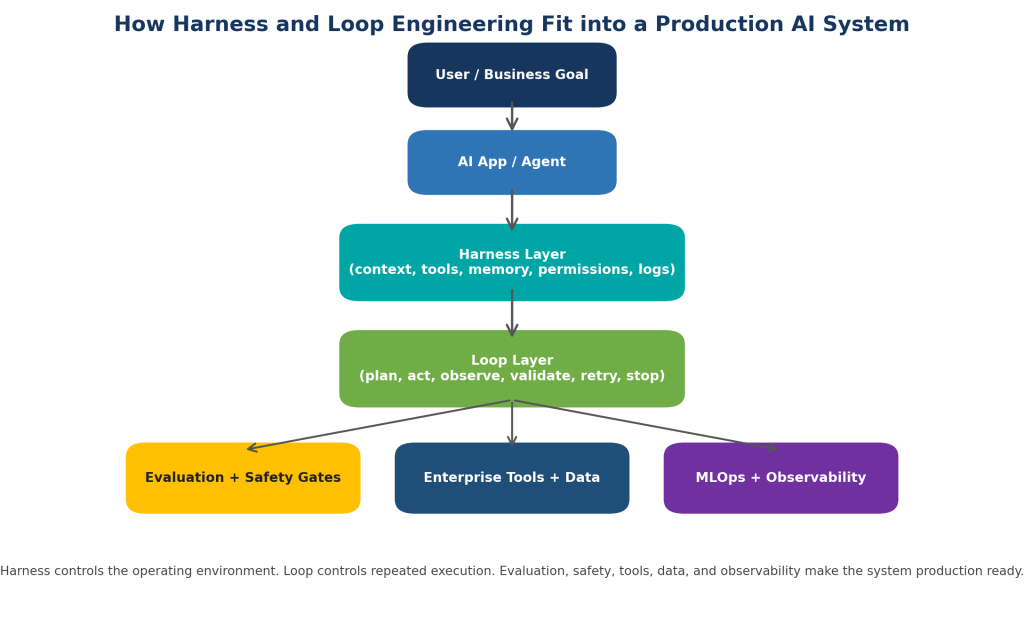
Harness Engineering and Loop Engineering are both advanced AI system roles. They become most important when an organization moves beyond simple chatbots and starts building agents that use tools, memory, validation, permissions, and governance.
4.1 Harness Engineering Fit
Harness Engineering is the control layer around the AI model and agent. It manages what the AI can see, remember, access, execute, approve, and log. It is closely connected with AI Architecture, Context Engineering, Tool Integration, AI Safety, Platform Engineering, and Governance.
- Controls tool permissions and approval gates.
- Manages context, session state, and memory.
- Defines runtime policies, logging, recovery, and observability.
- Prevents uncontrolled access to business systems and sensitive data.
4.2 Loop Engineering Fit
Loop Engineering is the execution reliability layer. It defines how an agent repeatedly moves toward a goal: plan, act, observe, validate, retry, escalate, and stop. It is closely connected with Agent Engineering, Evaluation Engineering, Tool Integration, Memory, and Domain Expertise.
- Defines goal-driven work cycles.
- Uses validation results to decide whether to continue or stop.
- Adds retry limits, cost limits, escalation, and failure handling.
- Prevents premature completion and uncontrolled infinite retries.
5. Detailed Roadmap by Learning Layer
Roadmap Step | Goal | Skills to Build | Practical Deliverable |
Step 1: AI Foundations | Build the base ability to create small AI applications. | Python, APIs, JSON, LLM basics, embeddings basics, FastAPI, Streamlit. | Build an AI summary generator and AI email assistant. |
Step 2: Prompt Engineering | Learn to control model behavior through reusable instructions and structured formats. | Role prompts, examples, output schema, tone control, prompt testing. | Build prompt templates for support replies, sales summaries, and report drafting. |
Step 3: Context Engineering | Learn to provide the right information to the model at runtime. | RAG basics, embeddings, vector search, chunking, metadata, context ranking. | Build a document Q&A assistant using company policy documents. |
Step 4: RAG and Knowledge Engineering | Build governed retrieval systems that ground AI in enterprise knowledge. | Document ingestion, hybrid search, citations, retrieval evaluation, data quality. | Build a knowledge assistant with citations and a quality score. |
Step 5: Agent Engineering | Build AI systems that use tools and complete multi-step tasks. | Tool calling, workflow state, API integration, task planning, escalation. | Build a sales or support agent that retrieves data and drafts action items. |
Step 6: Harness Engineering | Build the safe runtime environment around the agent. | Memory, permissions, approval gates, logging, tool restrictions, recovery. | Build an agent harness with CRM access, approval workflow, and audit logs. |
Step 7: Loop Engineering | Build repeated work cycles that validate, retry, and stop correctly. | Goal decomposition, validation loops, retry logic, stop conditions, timeout/cost limits. | Build a report-generation loop that validates totals and corrects missing sections. |
Step 8: Evaluation Engineering | Measure output quality, hallucination, correctness, completeness, and regressions. | Rubrics, golden datasets, LLM-as-judge, RAG evaluation, dashboards. | Build a quality scorecard for AI-generated call summaries. |
Step 9: AI Safety and Governance | Control risk, security, privacy, approval, and policy compliance. | PII detection, prompt injection testing, audit logs, policy enforcement. | Build a governance harness with DLP, approval gates, and audit reporting. |
Step 10: MLOps and AI Platform | Deploy, monitor, version, scale, and operate AI systems in production. | CI/CD, Docker, monitoring, model gateways, cost tracking, rollback. | Deploy a secure AI API with monitoring and evaluation gates. |
Step 11: AI Product and Architecture | Connect AI systems to business outcomes, adoption, architecture strategy, and ROI. | Use-case discovery, KPI design, architecture, governance, adoption planning. | Build an enterprise AI roadmap and architecture blueprint. |
Timeline | Focus | Tools | Deliverable |
Months 1-2 | AI Foundations | Python, APIs, Azure OpenAI/OpenAI, FastAPI, Streamlit, GitHub | AI summary generator and AI email assistant |
Months 3-4 | Prompt and Context Engineering | Promptfoo, Azure AI Search, Chroma, LlamaIndex, LangChain | Company document Q&A bot with prompt evaluation |
Months 5-6 | RAG and Knowledge Systems | Azure Document Intelligence, pgvector, Ragas, Power BI | Knowledge assistant with citations and quality score |
Months 7-8 | Agent Engineering | Semantic Kernel, OpenAI Agents SDK, LangGraph, AutoGen, Azure Logic Apps | Sales or support agent that retrieves data and drafts tasks |
Months 9-10 | Harness and Loop Engineering | Microsoft Agent Framework, LangGraph, OpenTelemetry, Azure Monitor, Promptfoo | Controlled agent harness with loop validation, memory, permissions, and logs |
Months 11-12 | Evaluation, Safety, Governance, and MLOps | DeepEval, Ragas, Purview, Presidio, MLflow, Docker, Azure DevOps | Secure AI assistant with evaluation gates, audit logs, monitoring, and approval workflow |
6. Tool Stack to Target
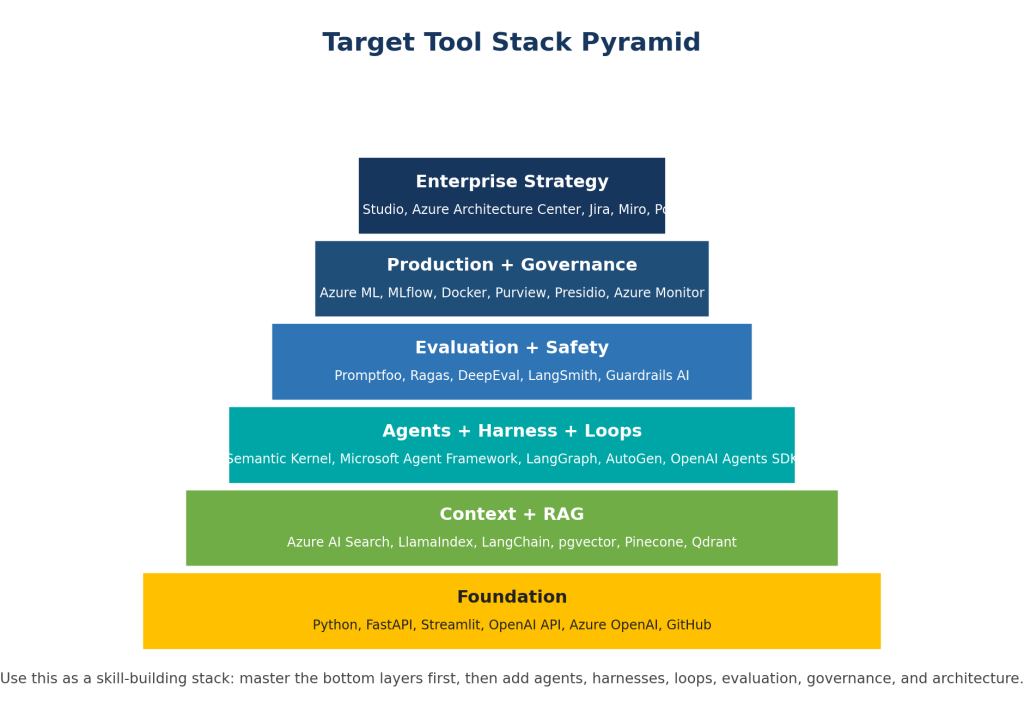
The recommended tool stack is organized as a pyramid. Start with foundations, then add context and RAG, then agents, harnesses and loops, then evaluation, governance, and production operations.
Core AI and Models
- Azure OpenAI
- OpenAI API
- Anthropic Claude
- Google Gemini
- Microsoft Copilot Studio
Application Development
- Python
- FastAPI
- Streamlit
- React basics
- GitHub
- VS Code
Context and RAG
- Azure AI Search
- LlamaIndex
- LangChain
- PostgreSQL + pgvector
- Pinecone
- Qdrant
- Azure Document Intelligence
Agents and Automation
- Microsoft Semantic Kernel
- Microsoft Agent Framework
- OpenAI Agents SDK
- LangGraph
- AutoGen
- CrewAI
- Azure Logic Apps
- n8n
Harness and Loop Engineering
- Microsoft Agent Framework
- Semantic Kernel
- LangGraph
- Claude Code
- OpenAI Codex
- Temporal
- Prefect
- GitHub Actions
Evaluation
- Promptfoo
- Ragas
- DeepEval
- LangSmith
- TruLens
- Arize Phoenix
Security and Governance
- Microsoft Purview
- Azure AI Content Safety
- Presidio
- Guardrails AI
- Azure Key Vault
- Microsoft Defender
Production and Monitoring
- Azure ML
- MLflow
- Docker
- Kubernetes basics
- OpenTelemetry
- Azure Monitor
- Grafana
- Datadog
7. Role-to-Tool Mapping
Role | Main Focus | Tools to Target |
AI Engineer | Build AI apps | Python, FastAPI, Streamlit, Azure OpenAI, OpenAI API |
Prompt Engineer | Improve instructions | Promptfoo, Azure AI Foundry, OpenAI Playground, Anthropic Console |
Context Engineer | Provide right information | Azure AI Search, Pinecone, Qdrant, LlamaIndex, LangChain |
RAG Engineer | Build knowledge retrieval | Azure Document Intelligence, pgvector, Weaviate, Ragas |
Agent Engineer | Build tool-using agents | OpenAI Agents SDK, Semantic Kernel, LangGraph, AutoGen, CrewAI |
Harness Engineer | Build controlled AI runtime | Microsoft Agent Framework, Semantic Kernel, OpenTelemetry, Guardrails AI |
Loop Engineer | Build iterative work cycles | LangGraph, Claude Code, OpenAI Codex, Temporal, GitHub Actions |
Evaluation Engineer | Measure AI quality | Promptfoo, Ragas, DeepEval, LangSmith, TruLens |
AI Safety Engineer | Reduce AI risk | Azure AI Content Safety, Presidio, Guardrails AI, Microsoft Purview |
MLOps Engineer | Deploy and monitor AI | MLflow, Azure ML, Docker, Kubernetes, Grafana, Datadog |
AI Product Manager | Define AI value | Jira, Miro, Power BI, Confluence, Azure DevOps |
AI Architect | Design enterprise AI | Azure Architecture Center, Copilot Studio, Semantic Kernel, Microsoft Graph |