AI, AGI, ASI: Three Different Things We Keep Calling One
Introduction: Decoding the "AI" Umbrella
In current boardrooms and classrooms, we frequently use the term “AI” as a catch-all label for everything from the algorithm that suggests your next movie to the hypothetical god-like machines of science fiction. As a curriculum architect, I must be clear: this linguistic “sloppiness” is more than a semantic quirk—it is costing teams real money and real credibility.
The Ladder of Intelligence provides a conceptual map to help us navigate this landscape, but it is not a confirmed itinerary. It is vital to understand that the stages we are about to discuss are not points on one “smooth line.” Moving from one rung to the next represents a monumental leap in logic and capability. Climbing the first rung does not guarantee we ever reach the second.
Key Takeaway There is a profound difference between a tool that finishes a sentence (predictive autocomplete) and a tool that thinks (cognitive autonomy). Confusing the two leads to misplaced expectations and significant strategic errors.
To build a functional mental model, we must start at the bottom, where every single piece of working technology on the planet currently resides.

Rung 1: Narrow AI (ANI) – "Competence in a Box"
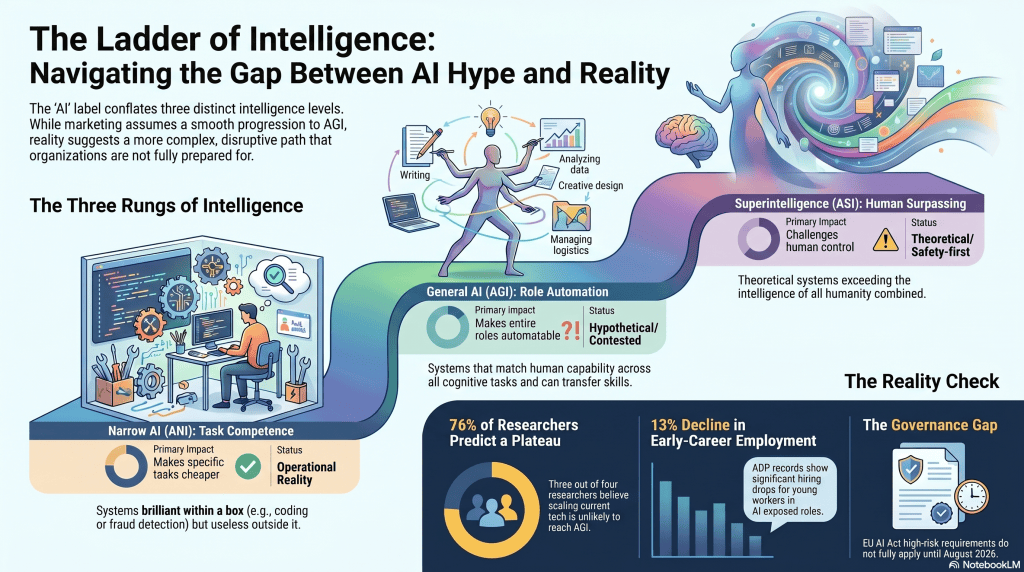
Artificial Narrow Intelligence (ANI) is the only form of AI that exists today. It is best described as “competence in a box”: a system can be brilliant within its specific boundaries but is entirely useless outside of them.
Narrow AI is defined by its lack of transferability. For instance:
- A model that can write sophisticated code is incapable of driving a car.
- A system trained for banking fraud detection cannot diagnose pneumonia from an X-ray.
Characteristics of Narrow AI
- Well-defined tasks: It excels at specific, programmed objectives or pattern recognition.
- Lack of cross-domain utility: Knowledge gained in one area cannot be applied to another without ground-up retraining.
- Current Reality: Every working AI system on earth right now is Narrow AI. All of it.
While ANI is brilliant within its confines, the next rung aims to remove the “box” entirely, transitioning from a tool that helps a human to a system that functions as a peer.
Rung 2: General Intelligence (AGI) – The Transferable Mind
Artificial General Intelligence (AGI) represents a “difference of kind” rather than just a “difference of degree.” While Narrow AI is a better tool, AGI aims to be a digital mind capable of transferability—the ability to learn a skill in one domain and apply it to a completely different one.
However, a key pedagogical insight is that even the people building it cannot agree on what “it” is. The target is constantly moving, defined primarily by two perspectives:
- The Philosophical Definition: A system that matches or surpasses human capability across virtually all cognitive tasks.
- The Economic Definition (OpenAI): “Highly autonomous systems that outperform humans at most economically valuable work.”
The “So What?”: The economic definition says the quiet part out loud—AGI moves the machine’s role from augmenting a person to replacing a functional role. If a system can perform “economically valuable work” autonomously, it no longer just makes a task cheaper; it automates the labor entirely.
The Shift: Narrow vs. General
Feature | Narrow AI (ANI) | General Intelligence (AGI) |
Scope | Single, specific, boxed tasks | Virtually all cognitive tasks |
Value | Makes specific tasks cheaper (Augmentation) | Automates entire functional roles (Replacement) |
Adaptability | Requires retraining for new domains | Cross-domain skill transfer |
As we move toward the final rung, intelligence shifts from human-level capability to a scale that exceeds our collective comprehension.
Rung 3: Superintelligence (ASI) – Beyond the Human Horizon
Artificial Superintelligence (ASI) is a theoretical stage mapped by philosopher Nick Bostrom. It describes a system that does not simply match the smartest human, but exceeds the collective intelligence of all humanity combined by a wide margin.
Lorem ipsum dolor sit amet, consectetur adipiscing elit. Ut elit tellus, luctus nec ullamcorper mattis, pulvinar dapibus leo.
Because an ASI would be better at thinking than we are, we face a fundamental crisis of agency. This is why leading labs increasingly treat ASI as a safety problem first and a product second.
Both OpenAI and Anthropic have signaled significant humility here; OpenAI has publicly admitted it does not yet know how to reliably “steer” or control superhuman AI, while Anthropic’s mission includes a willingness to “sound the alarm” if safety techniques fail to keep pace with capability.
“Once a machine exceeds human intelligence across the board, the question of who is steering becomes genuinely open.”
Reality Check: The Gap Between Hype and Research
As your mentor, I must highlight a profound mismatch between the aggressive marketing of AI companies and the skepticism of the research community. In the AAAI 2025 Presidential Panel, a survey of 475 AI researchers found that 76 percent believe simply scaling up today’s technology is “unlikely” or “very unlikely” to lead to AGI.
Data Spotlight: Three Honest Signals of Unreadiness
- The Organizational Gap: Most enterprises have not mastered Narrow AI. The bottlenecks are not “intelligence,” but poor data quality and a lack of governance. We are debating handing autonomy to systems we haven’t learned to supervise on simple tasks.
- The Labor Market Signal: A 2025 Stanford study using actual ADP payroll records found that early-career workers (ages 22–25) in AI-exposed roles saw a 13% decline in employment since generative AI went mainstream. This disruption is happening now, powered entirely by Narrow AI.
- The Regulatory Lag: Law moves slower than compute. The EU AI Act only began implementing general-purpose AI obligations in August 2025, with high-risk requirements not applying until 2026. Governance is structurally behind by design.
Mundane and Immediate Risks: Before we worry about a machine “seizing control,” we must address the risks of over-delegation (handing control to unvalidated systems), capability outrunning comprehension (deploying tools we cannot explain), and the definition vacuum where AGI becomes a marketing claim rather than a milestone.
Conclusion: Navigating the Evolution
The most important skill you can develop is the ability to refuse to confuse the rungs. Do not let the science fiction of Superintelligence distract you from the practical, urgent demands of the Narrow AI tools in your hands today.
Actionable Wisdom for the Future:
- Master the Narrow: Become an expert in current tools. The data shows most organizations are still struggling with the basics of data quality and oversight.
- Build Governance Early: Practice oversight on simple problems now. You need that “muscle memory” before more autonomous systems arrive.
- Maintain Intellectual Honesty: Treat every confident timeline with skepticism. The experts themselves are divided on whether our current path even reaches the next rung.
The teams that come out of this decade ahead will not be the ones who guessed the date. They will be the ones who got ready for either answer.
I am genuinely split on the timeline myself. So I leave you with this: Are we underestimating the speed of the next rung, or overestimating the current ladder’s reach? Your answer will define your strategy for the decade to come.