Salesforce Einstein AI: how it works for Sales Cloud
If I had to guess, I’d say that the man who famously said, “Never memorize something that you can look up,” would probably be pretty blown away by what’s possible today with artificial intelligence. That man, of course, was Albert Einstein, the face and namesake of Salesforce’s AI products and capabilities.
Einstein also once said, “If I had an hour to solve a problem, I’d spend 55 minutes thinking about the problem and 5 minutes thinking about solutions.” At Atrium, that sentiment really resonates with us.
Technology is only as useful as the strategic problem-solving users apply it to. The most powerful enterprise tools in the world aren’t worth much if you don’t understand your users, customers, and the challenges that need to be solved. With Salesforce Einstein, your people can now spend less time clicking and coding and more time thinking through business problems — and providing more efficient, personalized employee and customer experiences.
Salesforce offers a range of AI tools — both predictive and generative — under the Einstein umbrella. Einstein AI is embedded directly within the Salesforce platform to drive efficiency and personalization across the Customer 360 suite.
The native integration allows you to interact directly with AI to streamline your workflows and enhance customer experiences. From sales and marketing to service and support, Einstein enables data-driven decision-making. With user-friendly, low-code solutions, anyone can easily build AI-driven experiences.
The one thing you can always count on with Salesforce is that their products (and names!) will change and evolve. We’ll work to keep this guide updated as changes happen and new products and capabilities are announced.
The AI coworker accelerated sales
SALESFORCE RESEARCH Artificial intelligence for sales is at a tipping point, with high-performing sales teams nearly twice as likely to use AI than low-performing teams. But this technology didn’t emerge overnight.
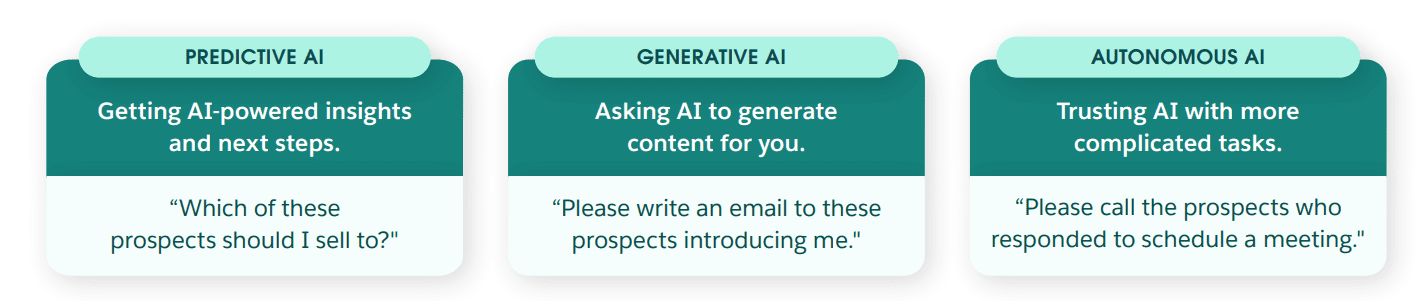
Predictive AI came first, a decade ago, with tools that monitor customer data and deliver insights and recommendations to sellers: the hottest leads, the deals at risk, and whether you’re on track to hit your forecast.
When generative AI burst onto the scene in 2022, AI wasn’t just telling us things anymore. It was creating content for us. It was summarizing calls, writing emails, and creating sales plays. We could talk to AI in conversations, not code. Even more recently, autonomous AI performs complex tasks like an assistant, such as chatting with website visitors and qualifying them into leads
What AI Innovation looks like for sellers
Einstein for Sales
Each of Einstein’s AI features is applied and at different stages of the sales process. Let’s have a look on how they bring benefits in real-world business practice:

1. Einstein Activity Capture
- Email. It’s a smart email assistant feature, which is the most useful for sales reps. Activity Capture is based on the NLP technology (which understands human language and that’s enable AI to analyze it and, in our case, take the most valuable insights from emails). This feature “reads” emails, distinguishes the most important ones, offers the next steps to do, or offers the way to answer. Emails that Einstein Activity Capture processes are automatically added to the activity timeline of related accounts, contact, lead, opportunity, contract, and quote records.
- Events. Sales staff can connect their emails to the My Events calendar in Salesforce. AI scans email content for events, and then events become Salesforce records, so your team can easily manage everything from Salesforce Sales Cloud.
- Contacts. For contacts, Einstein Activity Capture works almost the same as for events: contacts from the connected account are automatically added to the Salesforce database and become Salesforce records.
2. Einstein Lead Scoring
Make sure your sales team handles the hottest lead first. Einstein Lead Scoring applies ML and data science to discover the patterns from the history of lead conversion. The more leads you convert, the more information AI has for learning, and that’s how it becomes “smarter,” more and more valuable, and finds new emerging patterns. Based on your previous deals, AI compares converted leads with the new ones and finds what they have in common. Then AI prioritizes the existing leads and scores them according to the probability of conversion. Moreover, AI determines which fields influence each lead score the most.
3. Einstein Opportunity Scoring
An opportunity in Salesforce refers to the high probability of generating sales revenue. Opportunity Scoring works similarly to Lead Scoring: AI gives the score (from 1 to 99) to each opportunity in Sales Cloud and picks out the biggest deals most likely close in the pipeline. The higher the score, the higher the probability that the deal will go through.
4. Einstein Opportunity Insights
This feature is a useful addition to Activity Capture and Opportunity Scoring, producing valuable insights from the opportunities data. Using sentiment analysis (the NLP technique determines whether data is positive, negative, or neutral), AI recognizes client sentiments from the analyzed data. There are the following types of insights provided by Einstein under the Opportunity Insights:
- Deal Prediction
- Follow-Up Reminders
- Key Moments
5. Einstein Account Insights
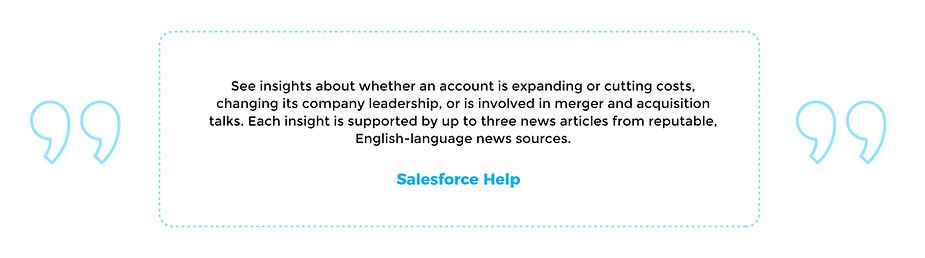
Stay kept up-to-date with the latest news that influences your business.
6. Einstein Forecasting
Don’t let your business shock you – make it predictable. Einstein Forecasting feature is based on ML and data mining AI technologies to bring more certainty and visibility to your forecasts. Here AI analyzes data from the CRM, tracks the sales teamwork, and predicts future deals.
7. Einstein Automated Contact
Einstein Automated Contact removes this problem from the Sales reps and identifies contacts based on the activities.
8. Einstein Analytics
Its advanced analytics platform that combines AI-powered insights, interactive dashboards, and predictive modeling to help businesses make smarter decisions using their Salesforce data. It’s designed for users across roles, especially sales managers—who need actionable insights without relying on data scientists
1. Real-Time Insights & Forecasting
- Provides real-time visibility into sales data and pipeline changes.
- Enhances forecast accuracy by analyzing trends and adjusting predictions dynamically.
- Helps managers stay ahead of market shifts and customer behavior changes.
📊 2. Performance Monitoring
- Enables tracking of individual and team performance against quotas.
- Offers dashboards with key performance indicators (KPIs) for quick evaluation.
- Identifies gaps between expected and actual performance to improve outcomes.
🔄 3. Pipeline Management
- Visualizes pipeline changes, including new deals and delayed opportunities.
- Compares won vs. lost deals to refine sales strategies.
- Helps in prioritizing tasks and reallocating resources effectively.
🧠 4. AI-Powered Recommendations
- Uses deep learning to suggest prescriptive actions based on data patterns.
- Automates repetitive tasks, freeing up time for strategic decision-making.
🕳️ 5. Whitespace Analysis
- Identifies untapped opportunities and areas for expansion.
- Helps sales managers discover cross-sell and up-sell potential.
📈 6. Data-Driven Decision Making
- Combines internal and external data sources for comprehensive analysis.
- Empowers managers to make informed, agile decisions that drive revenue