Microsoft Power Platform: Shaping the Future of SMBs
SMBs offer crucial support to the most global economies by creating employment opportunities and catalysing innovation. Most of them, however, are choked with limited resources, a lack of flexibility in operations, and an acute demand for quick decision-making. Tracey and Marcusalso continue to meet challenges that come with advancing technology as they are part of the problem-solving process as technology advances. Of all, there is one that has radically changed over the past several years, and the Microsoft Power Platform is undeniably one of them. This suite of low-code and no-code tools does get SMBs for real in automation of business processes, extracting insights from data, as well as building out custom applications with thevery same limited IT resources.
In this article, we will break down how Microsoft Power Platform is revolutionizing the SMBs, transforming them from what they already are now to the future state that would enable them to compete on a larger scale with more efficiency, innovation, and speed and agility needed to succeed.
The Evolution of SMBs: From Legacy Systems to Modern Platforms
Previously, SMBs have largely been dependent on manual work and outdated systems to carry out their activities. Such systems were usually the closed-loop systems, which did not allow information to flow from one department of an organization to the other, a scenario that led to a lot of wastage. Furthermore, a lot of SMBs failed to catch up to the digitization train that large enterprises were already on due to the high costs of deploying enterprise-level software solutions.
On the other hand, with the increase in cloud computing and SaaS solutions, SMBs started using affordable and scalable options. Microsoft Power Platform is a good example of this paradigm shift targeting the SMB market to develop custom applications, design workflows, and perform data analysis with little dependency on an expansive IT department.
Microsoft Power Platform: A Comprehensive Solution for SMBs
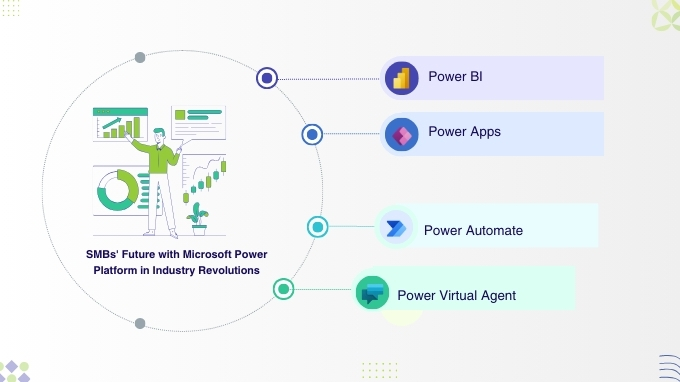
The Microsoft Power Platform consists of four key components: power BI, power apps, power automation, and power virtual agents. All of these tools serve different purposes in an SMB, yet when combined, they form the perfect environment that can revolutionize business. undefined
1. Power BI: Transforming data into Actionable insights
Power BI is an excellent tool in terms of data analysis and creating reports and dashboards for SMBs. Traditionally, data analysis was a very long process, and it needed people with lots of expertise. This makes Power BI easy to use because anyone in the company can build and distribute reports and visualizations. For SMBs, it means quicker processes and the possibility to act in response to the changes in the market.
2. Power Apps: Custom Applications Without the Code
Developing own applications was once a luxury that only large corporations could indulge in. Power Apps alters that by allowing SMBs to create bespoke applications with minimal or no coding involved. Businesses can choose an easy-to-implement app for inventory tracking and use Power Apps for building more complex solutions in customer relationship management for small businesses without causing high costs.
3. Power Automate: Streamlining Operations Through Automation
Another aspect important for SMBs is operational effectiveness, and Power Automate contributes to it by reducing time spent on monotonous tasks and maintaining the required level of organizational efficiency. This not only saves time but also avoids mistakes resulting from human involvement in the data processing. For instance, an SMB can apply Power Automate to create and handle invoices, notify its users, or update records within other systems. Control level of automation that was unachievable for most of the SMBs are now achievable and can easily be implemented by the use of Power Automate.
4. Power Virtual Agents: Enhancing Customer Engagement
Customer service has become a critical competitive advantage for SMBs, and Power Virtual Agents helps businesses build smart chatbots for customers’ round-the-clock support. These bots can be incorporated into sites, social media accounts, and corporate intranets, which reduces the burden on human workers and enhances the client journey.
How Microsoft Power Platform is Shaping the Future of SMB
As SMBs continue to adopt Microsoft Power Platform, the impact on their operations is becoming increasingly evident. Here’s how the platform is shaping the future of these businesses:
1. Increased Agility and Innovation
Another area where Power Platform stands out is the power to innovate quickly. SMBs can bring new solutions to market in real-time and adapt to market needs faster than at any time in the past. This agility makes SMBs capable of competing with even the biggest organizations and even challenging conventional industries.
2. Empowering Non-Technical Teams
Typically, it was a complex process to build new business applications with the desired functionality; this process involved technical expertise. Self-service mechanisms, particularly the Power Platform, allow non-technical teams to develop and maintain applications with minimal support from IT departments. This not only accelerates the process of creating a solution but also puts leaders of the business in a position where those who know it best create solutions.
3. Cost-effective Digital Transformation
The reason being that digital transformation usually tends to be very expensive. Such expenses are hard to justify for most SMBs, while the Power Platform offers a pretty cheap solution with enterprise-level capabilities for a fraction of the price. This enables SMBs more easily to modernize their operations without having to break the bank.
4. Enhanced Data-Driven Decision Making
With this, SMBs can afford to make more confident and data-driven decisions. Thus, enabling analysis of data in real-time and generation of actionable insight that would drive optimization of operations, improvement of customer experiences, and identification of new business opportunities becomes possible with SMBs. This is indeed a game-changer for SMBs to move from gut-feel decisions to data-driven strategies.
5. Future-Proofing Operations
With technology still rapidly changing, it is important that SMBs future-proof their operations in order to be capable of competing. Continuous updates within the Power Platform and integrations with other Microsoft services ensure that SMBs are kept current with state-of-the-art tools and functionalities. That in itself is a testament to continued support from Microsoft to keep SMBs ahead of the curve and at par with the shift in market conditions.
Real-World Success Stories
With Microsoft Power Platform, many SMBs have already started to realize the benefit. For example, one small manufacturing company used Power Apps to develop an inventory management system tailored to its needs. This decreased stockouts by 30%. Another SMB in the retail sector utilized Power BI in analyzing customer purchasing patterns and hence went on to develop sales by as much as 20%.
These success stories reveal just how the Power Platform has transformed the way SMBs across various vertical industries operate, engage their customers, and innovate, among many other ways the Power Platform is helping unlock opportunities for SMBs to achieve their business aspirations.
Conclusion: The Future is Now for SMBs with Microsoft Power Platform
The Microsoft Power Platform is much more than the tools themselves; it is a force for change in the SMB landscape. Through process automation, gaining insight, and innovating more quickly, the Power Platform is enabling the SMBs to compete on a global scale. As more and more SMBs adopt this platform, there needs to be an about-face in the way these businesses are run: an about-face toward agility, innovation, and data-driven decision-making.
This is a high time for SMBs to balance themselves in the increasingly digital world, to embrace, understand, and function in the world of Microsoft Power Platform. In fact, the future of SMBs is not just about survival but thriving, and that could only be ensured if Power Platform has been given a chance to unlock that great potential.